

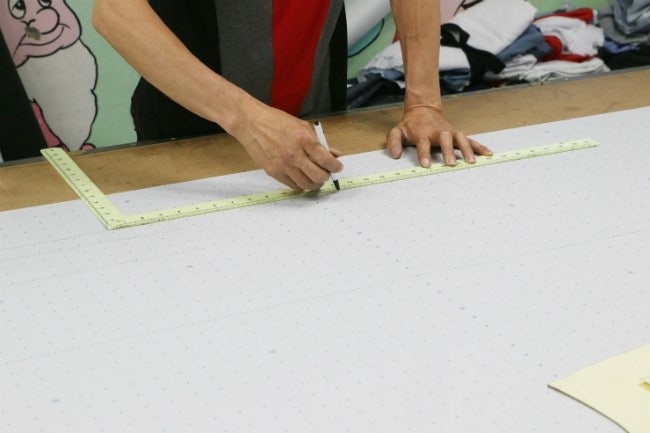
When people think about tote bags or fabric products, they often imagine sewing as the main skill behind the final result. But long before a needle touches the fabric, there is a crucial step that determines the quality, shape, and consistency of the product: cutting. In our workshop, we divide cutting into two major methods, each suited for different materials and production needs.
1. Cutting Machine: Ideal for Simple Shapes and Cotton Fabrics
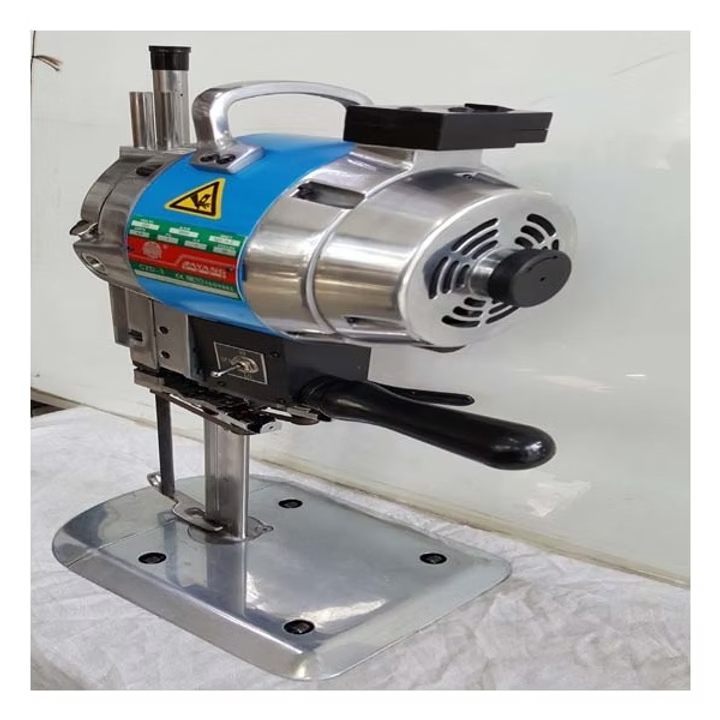
The first method uses a traditional cutting machine. Layers of fabric are stacked neatly, a pattern is drawn on the top layer, and the entire stack is cut following that outline. This approach works best for simple shapes and uncomplicated patterns. It is especially suitable for cotton fabrics that tend to fray easily, which is why it’s commonly used for eco‑bag production.
If you’ve ever ordered a basic cotton tote, chances are it was cut using this method.
2. Press Cutting: Consistent, Efficient, and Perfect for Coated Fabrics
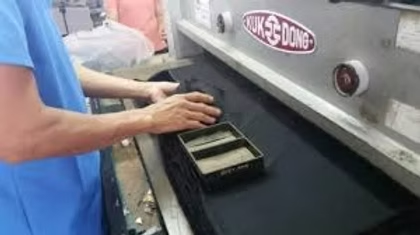
The second method is press cutting. Fabric is stacked, a sharp metal die is placed on top, and a press machine pushes down to cut the shape in one clean motion. This method is ideal for mass production because it produces perfectly consistent shapes. However, it works best with coated fabrics, which is why it’s widely used for structured bags and various commercial products.
Cutting isn’t just about machines. As customer demands shift toward 100% customization—from fabric selection to exact sizing—the complexity increases dramatically.
A few key challenges include:
- Seam allowance: Extra space must be added for stitching, and forgetting this can ruin an entire batch.
- Curved designs: When a bag has curves, the cutter must calculate circumference and adjust the pattern accordingly.
- Seasonal shrinkage: Fabric behaves differently depending on the season. In humid summer months, fabrics shrink significantly after heat treatment during printing. In winter, shrinkage is minimal. These variations must be calculated into the cutting size.
- Fabric grain: Even when using the same fabric roll, the grain direction affects print texture and color tone. If ignored, the final products may show noticeable color differences.
Efficiency Matters More Than People Realize
After considering all the technical factors, efficiency becomes the final challenge. Our commonly used 10oz and 20oz fabrics come in a 160cm width. Depending on whether we divide this width into three, four, or five sections, we get our standard bag widths: 50cm, 37cm, and 29cm. Cutting outside these ranges leads to wasted fabric that cannot be reused because the grain direction cannot be rotated.
Dyed fabrics add another layer of complexity. During the dyeing process, about 10cm of shrinkage occurs, which changes the standard widths to 47cm, 34cm, and 27cm.
The Final Level: Cutting That Breathes With Sewing
True mastery in cutting goes beyond precision. It requires understanding how sewing works. Good cutting doesn’t just create the shape—it supports the sewing team by marking guidelines, removing obstacles, and preparing pieces in a way that speeds up the stitching process. This isn’t something that can be taught with rules; it’s a skill built through experience and intuition.
At YourFactory, we’re not perfect yet. We’ve made mistakes, wasted yards of fabric, and started over more times than we’d like to admit. But we’re learning, improving, and building our own database of knowledge. Because we know the direction we’re heading, each day brings us closer to making better bags than the day before.
Cutting is something anyone can attempt—but doing it well is an entirely different craft.
Leave a Reply
You must be logged in to post a comment.